Sign up for Lesson Plans, discounts & more!
Amazonite
Uncommonly Beautiful Feldspar
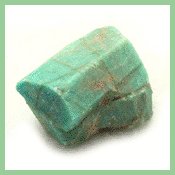
Amazonite is a beautiful green variety of microcline feldspar. Its chemical formula is KAlSi3O8 , potassium aluminum silicate.
Microcline refers to the crystal structure of the crystals. Microcline feldspars have angles slightly less than 90 degrees.
An Abundance of Feldspars
In the earth’s crust the feldspars are the most abundant mineral by far.
Microcline is the common potassium feldspar found in pegmatites. But
the green variety of microcline feldspar is a rare occurrence. It is
believed that the green color comes from traces of lead and OH-1
Alkali or Plagioclase
Feldspars can be alkali or they can be plagioclase. Amazonite is the pure potassium end member of the alkali group. It crystallizes at relatively low temperatures.
A Low Crystallization Temperature
At low crystallization temperatures the potassium feldspar, Amazonite,
and the sodium feldspar, albite, separate into layers. This is seen as
thin white bands of albite within the green crystal.
Schiller
One quality that makes this stone popular is schiller. Schiller is
similar to iridescense. It comes from light reflecting off different
planes within the crystal structure of the mineral. Light reflects
differently in each of these minerals causing the effect of schiller.
A Description
Amazonite is popular in jewelry and decorative objects as well as
specimens for mineral collectors. It is usually light green to blue
green and is found in granite and pegmatites. It has a range of 5 to 6
on the Mohs Scale.
Location
Large prismatic crystals are found in the Pike’s peak area of Colorado,
the ILmen mountains of Russia, they can also be found in Madagascar, and
Brazil. The specimens from Colorado are sometimes found with smoky
quartz, orthoclase, and albite. When this is the case the value of the
specimens is much higher.
Color(s): light green to blue green
Streak: White
Luster: vitreous
Transparency: translucent to opaque
Crystal system: triclinic
Crystal Habits: include blocky, or tabular crystals. Crystals are close to rectangular or square cross-section; Twinning is common.
Specific Gravity: About 2.5 depending on the specimen
Hardness (Mohs): 6 to 6.5
Cleavage: perfect in one and good in another direction forming nearly right angled prisms.
Fracture: conchoidal
Uses: Mineral Specimens, jewelry and ornamentals
Associated Minerals: quartz, muscovite and plagioclase feldspars.
Location: Includes Pikes Peak region of Colorado in the USA; Russia; Brazil; and Madagascar.
Amazonite Folklore, History, and Healing Properties
What's In A Name?
Some say the name comes from the Amazon River. This beautiful green
stone has been found in Brazil but not close to the Amazon. This stone
has been known and used by man for thousands of years. Long before the
Spanish discovered this mighty river in 1541.
In Greek Mythology the Amazons were a nation of women warriors. While there is disagreement over the historical existence of the Amazons as a people it is likely the source of the name of this stone.
The name microcline can also be attributed to the Greeks. Mikron = little and klinein = stoop. Loosely translated we get “leaning a little”. Microcline cleaves at a slight inclination from 90 degrees.
The ancients called amazonite the stone of courage. It has also been attributed with hope and confidence.
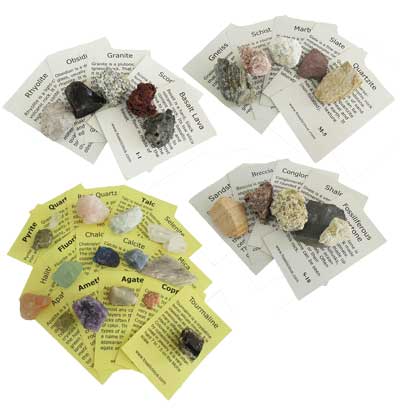

INTERESTED IN MORE? IF SO, YOU MAY WANT TO CHECK OUT OUR OTHER SITES:
fossilicious.com - Our online fossil and mineral rock shop.
fossils-facts-and-finds.com - An educational site about fossils.